
Follow Us




In short, the palm fruit digester thermally and mechanically prepares palm fruits before pressing, while the palm oil presser squeezes out the crude palm oil from the digested pulp. They are sequential partners in the same production line — one prepares, the other extracts. If you’re planning a palm oil processing business, understanding the difference between these two core machines is essential for building an efficient palm oil production line and choosing equipment that delivers high oil yield with low operating costs.
In this guide, you’ll learn exactly how each machine works, what they do differently, how to select the right type and capacity, and why the synergy between them directly impacts your bottom line.
A palm fruit digester is a pre-processing machine that sits between the threshing stage and the pressing stage in a palm oil processing machine production line. Its job is to thermally cook and mechanically digest sterilized palm fruits into a uniform hot pulp — making oil cells easy to release during the pressing stage.
Specifically, the palm fruit digester achieves three objectives:
(1) Mechanical cell rupture: Rotating stainless steel stirring arms (digester knives) continuously pound the palm fruit, breaking down fiber structure and rupturing oil—bearing cells to free the oil.
(2) Thermal conditioning: Steam coils around the palm fruit digester body maintain pulp temperature at 90–95°C, which reduces oil viscosity, breaks down pectin, and helps oil droplets coalesce for easier separation.
(3) Feed preparation: The digested pulp becomes a homogeneous slurry, ensuring even and consistent feed into the palm oil presser — maximizing pressing efficiency and final oil extraction rate.
Henan Glory manufactures vertical palm fruit digesters after extensive production feedback showed traditional horizontal designs often result in short retention time, incomplete digestion, and lower oil yield. The vertical design extends material retention time, ensuring more thorough cell rupture and better oil release.
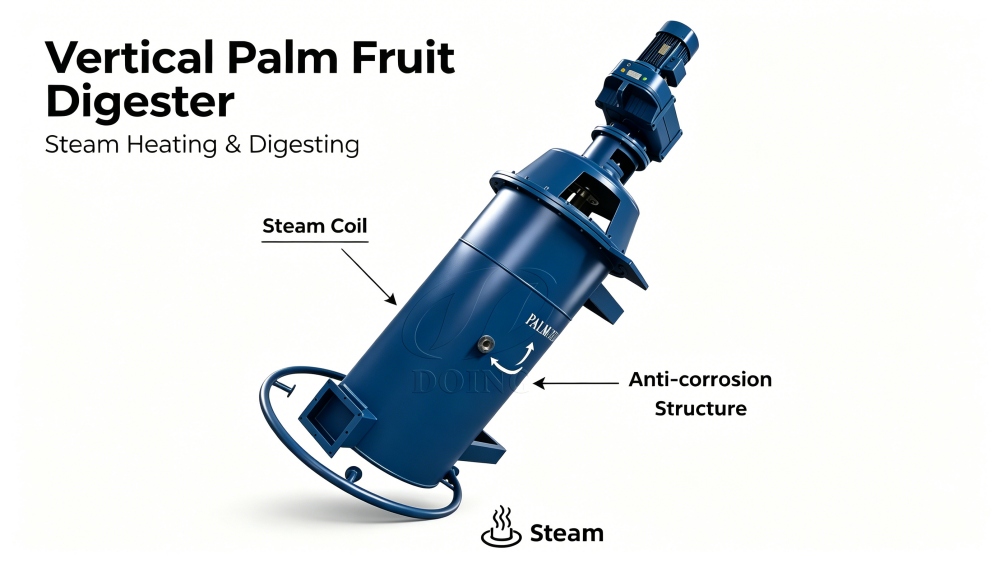 Henan Glory's vertical palm fruit digester
Typical Palm Fruit Digester Specifications
Rotation speed: 25–26 RPM
Capacity range: 1–15 TPH (customizable)
Temperature: 90–95°C via indirect steam heating
Structure: Vertical cylinder with multi-tier stainless steel stirring arms, pressure gauges, safety valves, and temperature sensors
A palm oil presser (also called a palm oil expeller) is the oil extraction machine that takes digested palm fruit pulp and applies high mechanical pressure to squeeze out crude palm oil. It is the machine that directly determines your oil output and extraction efficiency. Henan Glory offers two main types:
Capacity: 300-500 kg/hour
Best for: Small family workshops, home-based production, areas with unstable electricity
Power options: 4kW electric motor or 8hp diesel engine
Advantage: Keeps palm kernels largely intact during pressing — you can sell the kernels as an additional revenue stream
Typical use: Can operate standalone without a full palm oil processing machine production line
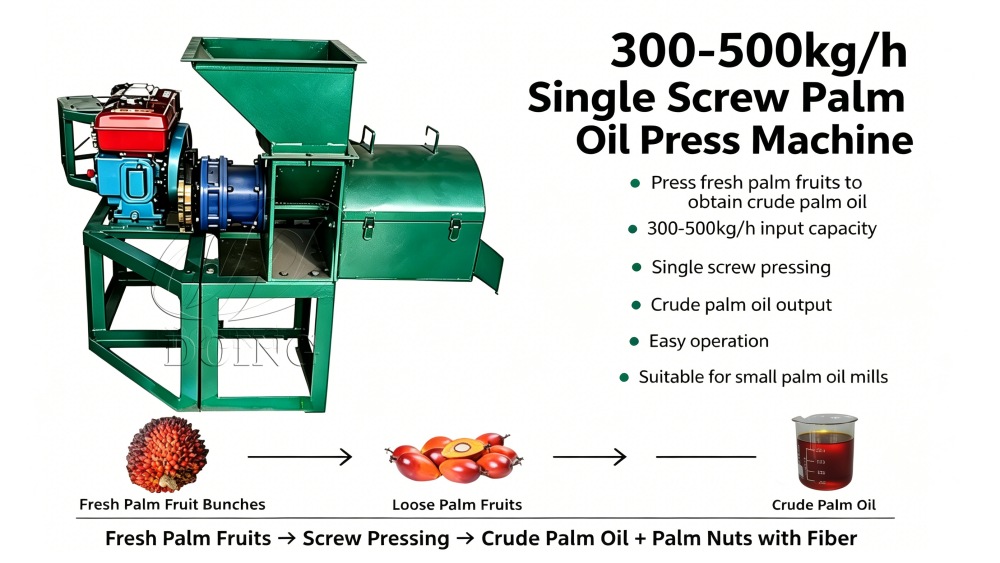 Single screw palm oil presser
Capacity: 1-15 tons/hour
Best for: Medium-to-large scale palm oil factories and production lines
Working principle: Two screws rotate in opposite directions, creating strong and stable squeezing force
Residual oil rate: Only 6%–7% in press cake (meaning higher extraction efficiency)
Hydraulic system: Up to 100MPa pressure, allowing real-time adjustment for optimized results
Screw material: 2Cr13 wear-resistant alloy steel (integral casting process) — lasts 6 months to 1 year under normal maintenance, significantly reducing replacement costs
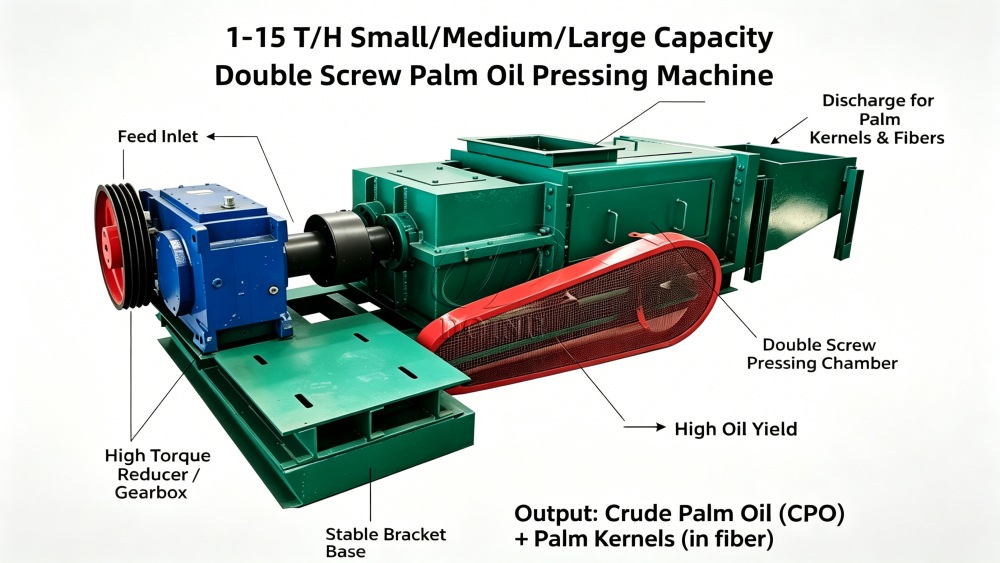 Double screw palm oil presser
| Feature | Palm Fruit Digester | Palm Oil Presser |
| Primary role | Pre-treatment (cooking + digesting) | Oil extraction (squeezing) |
| Working principle | Thermal + mechanical stirring | High-pressure mechanical compression |
| Output | Digested pulp | Crude palm oil + press cake (fiber + palm kernels) |
| Structure type | Vertical cylindrical tank with steam jacket + stirring arms | Press chamber and press screw (single or double screw) |
| Temperature | 90–95°C (maintained by steam) | N/A (receives feed) |
| Position in line | Before pressing | After digestion |
| Capacity range | 1–15 TPH | 300kg/h – 15 TPH (single/double screw options) |
| Standalone use | No — requires presser downstream | Yes (especially single screw for small workshops) |
In commercial palm oil milling, skipping the palm fruit digesting machine results in low oil extraction rates (OER) because the screw palm oil press machine alone cannot rupture the tough fruit mesocarp cells, leading to significant oil loss in fiber. Additionally, feeding undigested fruit causes high kernel breakage, which ruins crude palm oil quality and destroys a secondary revenue stream. Properly digesting fruit converts it into a lubricated mash, reducing friction and extending the lifespan of screw worms and press plates by up to 50% while lowering energy consumption.
Scenario A: Small workshop (<1 TPH, family-run) → Single-screw palm oil presser only (no digester needed for very small scale)
Scenario B: Medium plant (1-5 TPH) → Vertical palm fruit digester + double-screw palm oil presser
Scenario C: Large commercial mill (>5 TPH) → Vertical palm fruit digester (custom capacity) + double-screw palm oil presser + downstream refining equipment
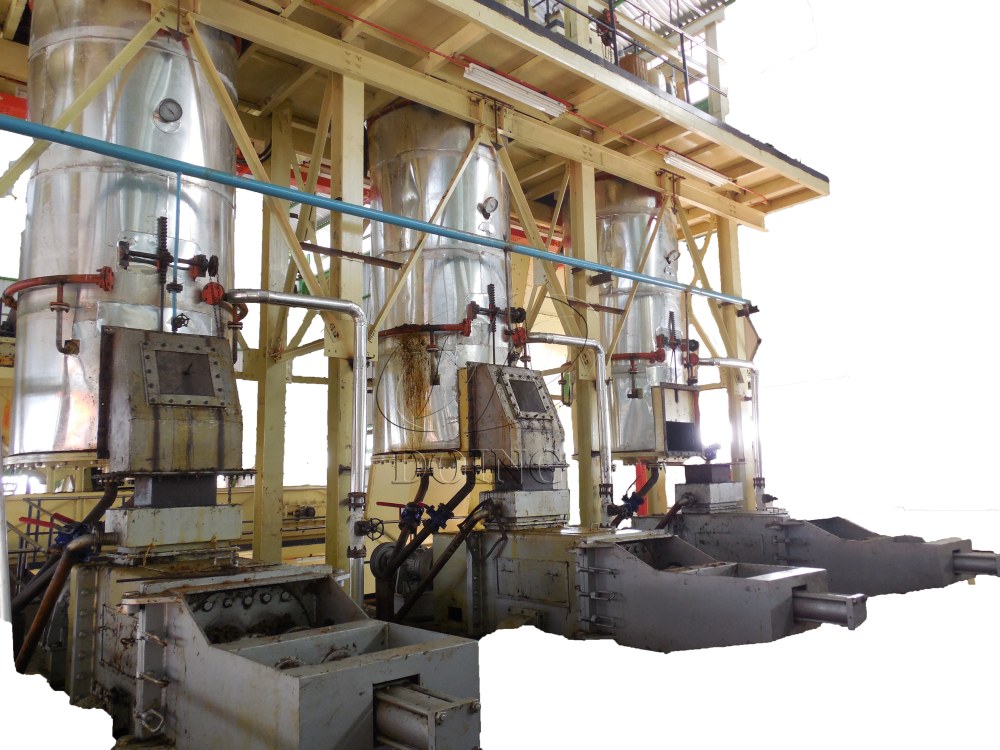 Large commercial palm oil mill
Not sure which configuration fits your budget? Contact our engineering team for a free capacity calculation and customized layout design.
When budgeting for your palm oil processing line, consider these real‑world factors:
| Aspect | Digester | Presser |
| Initial investment | Moderate (steam boiler extra) | Higher for double‑screw, lower for single‑screw |
| Daily energy cost | Steam generation (fuel) | Electricity or diesel |
| Wear parts | Stirring arms (replace every 1‑2 years) | Screw worms / press rings (replace every 6‑12 months for double‑screw) |
| Labour requirement | Low (automated control) | Moderate (feeding and cake discharge monitoring) |
| Maintenance tips | Check steam traps and seals regularly | Use high‑quality alloy screws; adjust hydraulic pressure based on feed moisture |
Q1: What happens if the digester temperature is too low?
A: Below 85 °C, oil viscosity remains high and pectin does not break down, leading to poor oil release and higher residual oil in the press cake.
Q2: How do I choose between single‑screw and double‑screw pressers?
A: Single‑screw is cheaper, simpler, and keeps kernels whole – ideal for small mills. Double‑screw gives higher capacity and lower residual oil – recommended for medium to large operations.
Q3: How often should I replace the stirring arms in the digester?
A: With normal use and proper steam control, stirring arms last 1‑2 years. Inspect them every 6 months for wear.
Ready to build your efficient palm oil processing line? Contact our engineering team for:
· Customized configuration based on your capacity goals and budget
· Capacity calculation (how many tons FFB/day can your plant handle?)
· On-site layout support (equipment placement, workflow optimization)
· Free quote in 24 hours (including digester, presser, and auxiliary equipment)
We will help you match the right digester and presser to your specific needs — ensuring maximum profitability from day one.
Please answer the questions bellow before leaving the message. Our sales manager will contact you within 24 hours. And your contact information will be protected!